


For our first full day of Nockmas, we will look at Nock's first opcode. If you have a running urbit, you can experiment with this from the Arvo command line, or 'dojo'. No running ship yet? Get started here. Of course, you can just follow along in this article, or even sketch out the basic Nock formulas and tree structures on a piece of paper as you go.
Opcode 0: Address
Syntax
Opcode 0 implements the idiomatic / "fas" slot operator, which retrieves a noun at a specified address within the subject.
*[a 0 b] /[b a]
Before discussing opcode 0, the addressing operator, we need to explore how nouns are structured in Nock.
Nouns
The fundamental data structure of Nock is the noun, which is either an atom (a non-negative integer) or a cell (an ordered pair of two nouns). Nouns can be visualized as binary trees, in which atoms are leaves and cells are internal nodes.
This leads to a convenient addressing scheme for nouns, for which each noun and sub-noun can be assigned a unique address based on its position in the binary tree. The addressing scheme works as follows:
/[1 a]              a
/[2 a b]            a
/[3 a b]            b
/[(a + a) b]        /[2 /[a b]]
/[(a + a + 1) b]    /[3 /[a b]]
/a                  /a
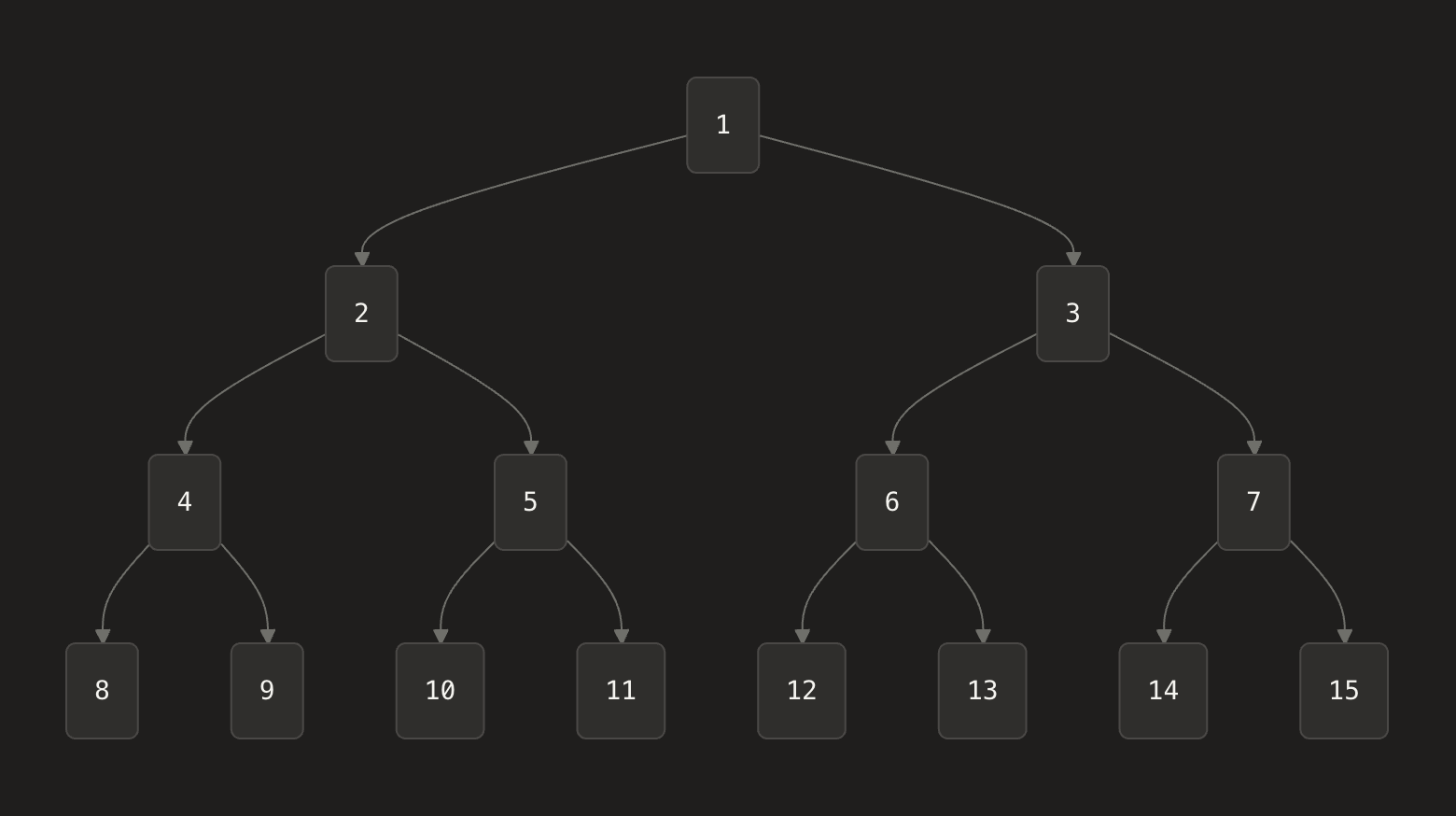
That is, the left-hand daughter of a cell is addressed by doubling its mother's address, while the right-hand daughter is addressed by doubling its mother's address and adding one. The root of the tree is always at address 1.
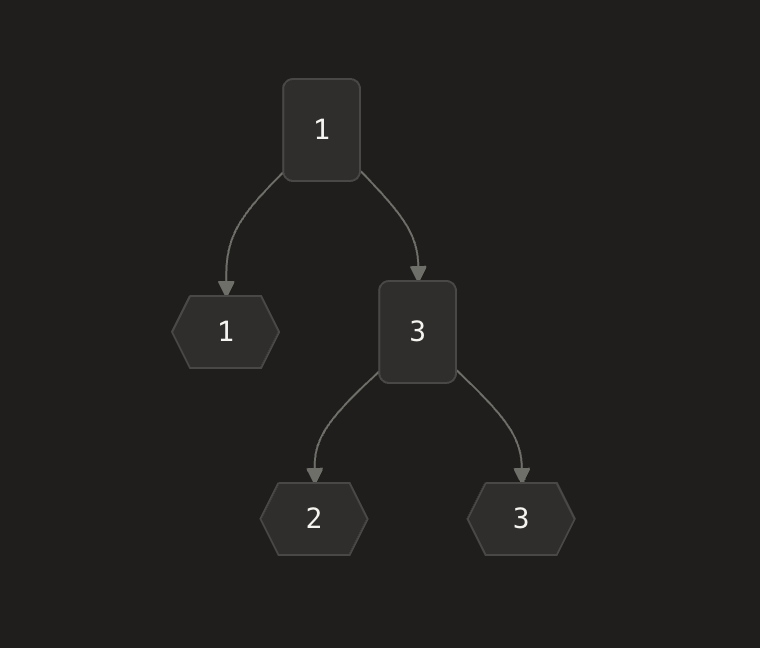
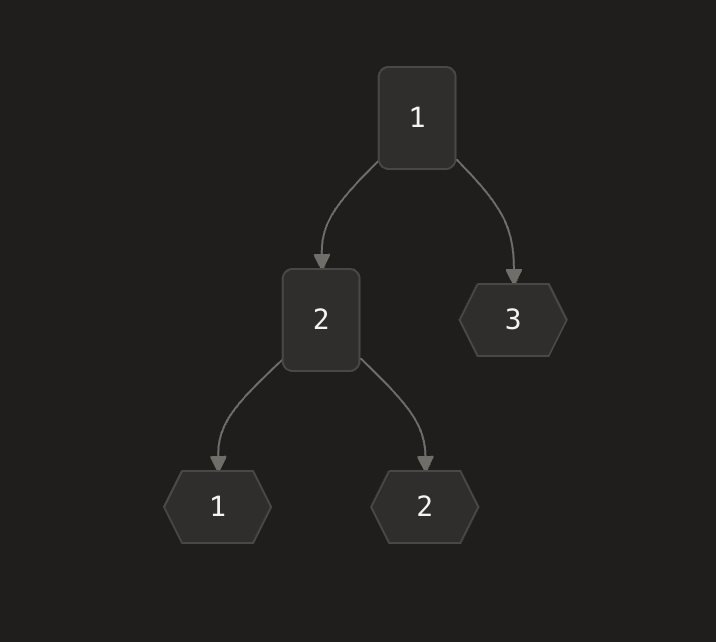
Of course, that's just an addressing scheme: it tells you how a noun is laid out, but not which positions are actually occupied. Let's see some examples. In these, we will use ⬡ to denote atoms (leaves) and ▢ to denote cells (internal nodes).
[[41 42] [43 44]]
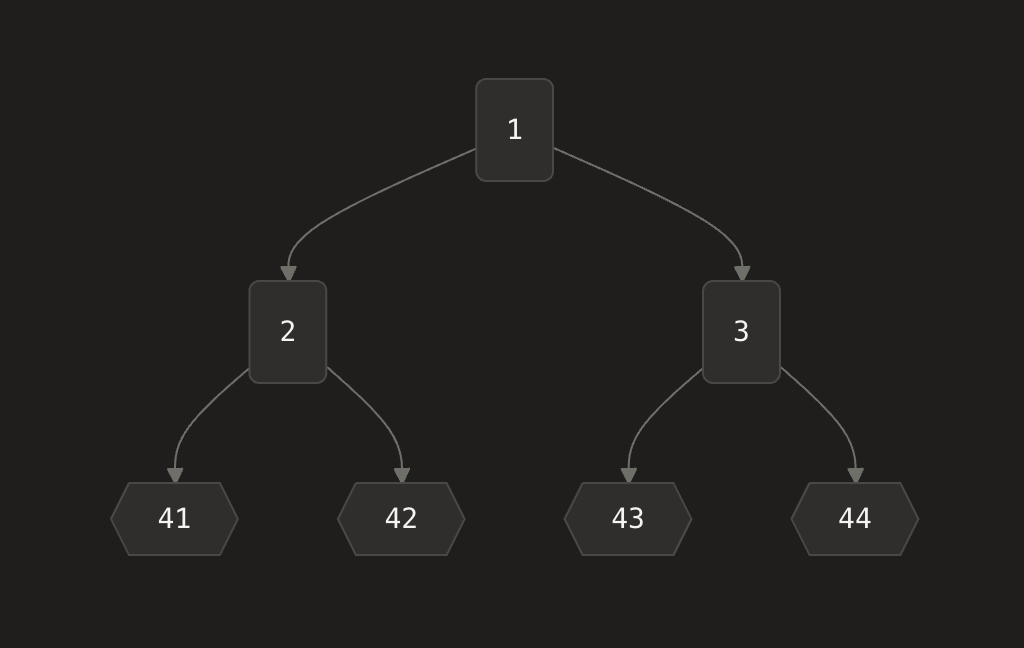
[1 [2 3]]
[a b c] [a [b c]]
We often omit the right-hand cells since cells tend to branch strongly right in practice. (This saves us from Lisp-style end-paren piles.)
[a b c] [a [b c]]
Thus, [1 [2 3]] can be written equivalently as [1 2 3].
[[1 2] 3]
Syntax (Redux)
/[1 a]              a
/[2 a b]            a
/[3 a b]            b
/[(a + a) b]        /[2 /[a b]]
/[(a + a + 1) b]    /[3 /[a b]]
/a                  /a

*[a 0 b]            /[b a]
Explanation
The / fas or slot operator describes how to navigate a noun given an address as an atom. The address is interpreted as a path through the binary tree, starting at the root (address 1). Each even number indicates a left branch, and each odd number indicates a right branch. The process continues until the address 1 is reached, at which point the corresponding noun is returned.
Most of the time, we expand the tree out to the conceptual binary tree map above rather than recursively apply the / fas slot rule.
Opcode 0 is used to retrieve the noun at address b within the subject. b must be a positive atom (the address).
Opcode 0 crashes if the address doesn't exist (e.g., addressing into an atom). Since there is no address 0, we use /[0 a] or [a 0 0] to denote a crash.
Binary
Addressing becomes particularly easy to read in binary form, in which a 0 bit corresponds to a left branch and a 1 bit corresponds to a right branch. We ignore the first bit (1, the root) and read the path in binary:
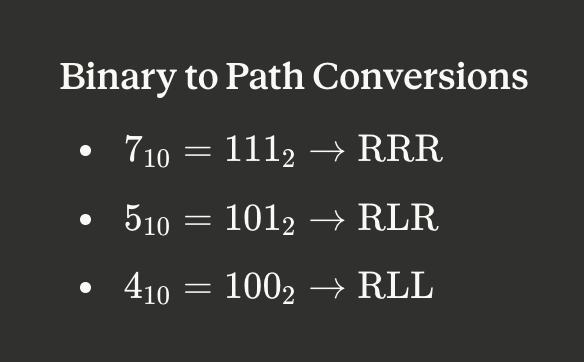
You will notice other patterns, e.g., that the rightmost child at a particular level is equal to a power of 2 minus 1.
Examples
Imagine you have the following noun in your subject, represented here as a binary tree: 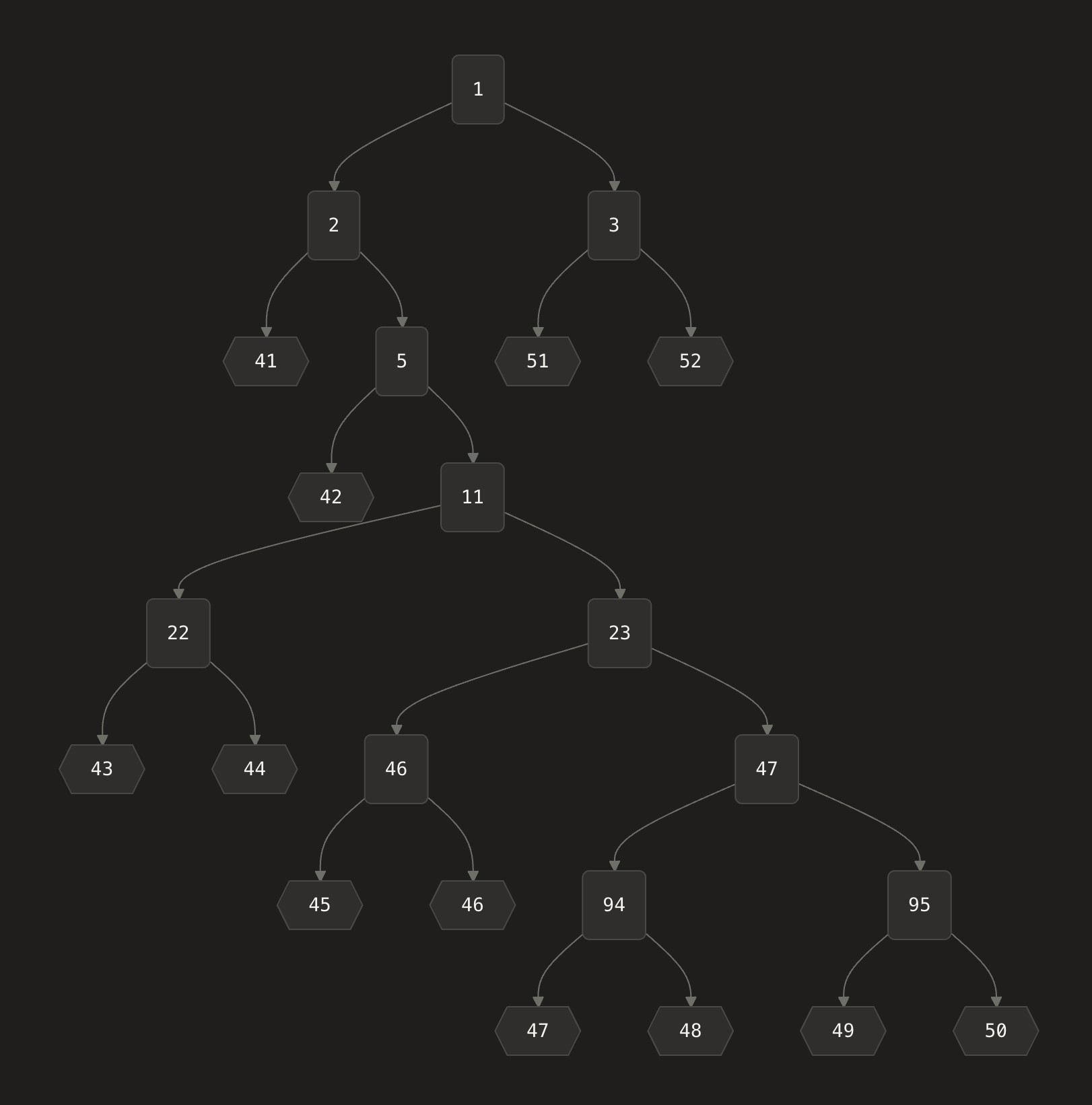
Or as a Nock formula:
:subject [[[41 42 [43 44] [45 46] [47 48] [49 50]]] [51 52]]
If you had this as your subject in your dojo, and ran Nock 0: Input:
[0 2]
Output:
[41 42 [43 44] [45 46] [47 48] 49 50]
Input:
[0 3]
Output:
[51 52]
Join us tomorrow when we cover Nock 1, Constant.
12 Days of Nockmas is an exploration of Nock, Urbit's instruction set architecture. This ISA is used by both Urbit and Nockchain, has interpreters written in many languages, with production versions in both C and Rust. The content of this series is drawn from the Nock language site. Visit the site for interactive code examples and more Nock related content.


